

The mil dot reticle or more accurately, MRAD (milliradian) reticle systems represents the gold standard for tactical and long-range precision shooting, adopted by military snipers, law enforcement, and competitive shooters worldwide for good reason. When you need to range targets using reticle subtensions, make precise wind holds without dialing turrets, or communicate firing solutions to teammates using a standardized measurement system, MRAD scopes provide capabilities that traditional hunting reticles simply can’t match.
The beauty of mil-based systems lies in their mathematical simplicity: working in base-10 decimals makes calculations fast and intuitive when you’re under pressure, ranging steel targets at unknown distances, or adjusting for wind that’s pushing your bullets around at 600+ yards.
Vortex Optics has embraced MRAD reticles across their tactical scope lineup, offering options from budget-friendly Diamondback Tactical models up through premium Razor HD systems that compete with scopes costing twice as much from other manufacturers.
What makes Vortex particularly appealing for MRAD applications is how they understand that tactical shooters need more than just a mil reticle slapped into any scope. They need first focal plane designs where the reticle scales with magnification to maintain accurate subtensions at any power, exposed turrets with matching MRAD adjustments, and optical quality that supports target identification and bullet trace observation at extreme distances. The legendary VIP unlimited lifetime warranty provides additional peace of mind because tactical shooting puts serious demands on equipment.
Understanding what makes the best Vortex mil dot scope requires recognizing that not all MRAD reticles serve the same purpose. Traditional mil-dot designs feature simple dots spaced at one-milliradian intervals, which work beautifully for ranging and basic holdovers but lack the dense Christmas tree-style hash marks that modern precision shooters demand for complex wind holds and rapid target engagement.
First focal plane versus second focal plane placement dramatically affects usability. FFP reticles maintain accurate subtensions at any magnification, critical for ranging and holds, while SFP reticles only provide accurate measurements at maximum power. Turret quality matters enormously because you’re dialing adjustments constantly in tactical shooting, making crisp, repeatable clicks with zero mechanical slop non-negotiable.
In this comprehensive guide, I’m breaking down the five best Vortex mil dot scopes specifically for tactical shooting, long-range precision, and competitive applications where MRAD systems provide genuine advantages. These aren’t hunting scopes with mil reticles awkwardly grafted on, they’re purpose-built tactical optics designed around the mil system from the ground up. Whether you’re shooting PRS competitions, engaging steel at varied unknown distances, or building a precision long-range rifle for serious shooting, one of these Vortex MRAD scopes will provide the features and performance to support your goals.
Top 5 Best Vortex Mil Dot Scope
- Best Overall: Viper PST Gen II 5-25×50 – Perfect balance of features and quality
- Best Budget: Diamondback Tactical 6-24×50 FFP – FFP MRAD at incredible price
- Best SFP Option: Viper HS-T 6-24×50 – Premium glass with refined turrets
- Best Premium: Razor HD Gen II 4.5-27×56 – Ultimate tactical scope performance
- Best High-Mag Value: Strike Eagle 5-25×56 – Maximum magnification and light gathering
Comparison Table
| Scope Model | Magnification | Objective | Weight | Reticle | Focal Plane | Price Range |
|---|---|---|---|---|---|---|
| Viper PST Gen II 5-25×50 | 5-25x | 50mm | 28.8 oz | EBR-2C MRAD | FFP | $900-1200 |
| Diamondback Tactical 6-24×50 | 6-24x | 50mm | 24.5 oz | EBR-2C MRAD | FFP | $400-500 |
| Viper HS-T 6-24×50 | 6-24x | 50mm | 22.6 oz | VMR-1 MRAD | SFP | $700-900 |
| Razor HD Gen II 4.5-27×56 | 4.5-27x | 56mm | 48.5 oz | EBR-2C MRAD | FFP | $2400-2800 |
| Strike Eagle 5-25×56 | 5-25x | 56mm | 27.3 oz | EBR-7C MRAD | FFP | $600-750 |
Vortex Viper PST Gen II 5-25×50 FFP (Best Overall MRAD Scope)

When discussing the best Vortex mil dot scope for serious tactical and long-range applications, the Viper PST Gen II 5-25×50 FFP stands as the obvious top recommendation for most shooters. This scope represents Vortex’s sweet spot where premium features, excellent optical quality, and tactical capabilities converge at a price point ($900-1200 depending on sales) that remains accessible compared to ultra-premium Razor systems.
The 5-25x magnification range provides perfect versatility, low enough at 5x for closer engagements and situational awareness, yet powerful enough at 25x for precise shooting and target identification at 1000+ yards where you’re watching bullet trace and making wind calls based on mirage and environmental indicators.
The first focal plane EBR-2C or EBR-7C MRAD reticle is what makes this scope genuinely tactical rather than just a hunting scope with mil markings. The Christmas tree-style hash marks provide dense holdover points for both elevation and windage, enabling fast, accurate holds without constantly dialing turrets when engaging multiple targets at varied distances.
The reticle scales proportionally with magnification, maintaining accurate subtensions whether you’re at 5x or 25x, this means you can range targets, make wind holds, and use reticle subtensions for measurements at any power setting. This FFP functionality is absolutely critical for tactical shooting where you might need to quickly zoom down for situational awareness then back up for precision without losing reticle accuracy.
What separates the PST Gen II from lesser tactical scopes is optical quality that genuinely supports long-range precision work. The XD extra-low dispersion glass delivers exceptional image clarity with outstanding color fidelity and excellent contrast even in challenging conditions. The XR fully multi-coated lenses maximize light transmission, creating bright images that remain usable during marginal light periods.
At maximum magnification, the scope maintains impressive clarity that doesn’t degrade into soft, muddy images like budget tactical scopes do. When you’re trying to spot 10-inch steel plates at 800 yards or read mirage for wind calls, that optical quality genuinely affects your success rate.
The exposed tactical turrets offer precise 0.1 MRAD adjustments with audible and tactile clicks that inspire absolute confidence when dialing elevation or windage. Each click is distinct and positive. You’ll never wonder if you moved one click or two. The turrets feature tool-less zero reset capability, making it simple to return to zero after dialing for distance.
Total adjustment range provides 18 MRAD elevation and windage, which is adequate for most tactical shooting applications out to 1200+ yards depending on your cartridge. The locking turrets prevent accidental adjustment during transport or field movement, yet unlock instantly when needed.
Key Features
| Feature | Specification |
|---|---|
| Magnification | 5-25x |
| Objective Lens | 50mm |
| Eye Relief | 3.8 inches |
| Field of View | 21.1-4.4 ft @ 100 yards |
| Tube Diameter | 30mm |
| Length | 14.9 inches |
| Weight | 28.8 oz |
| Reticle | EBR-2C or EBR-7C MRAD (FFP) |
| Waterproof/Fogproof | Yes (Argon purged) |
| Warranty | VIP Unlimited Lifetime |
Pros
- Perfect magnification range for tactical and long-range shooting
- First focal plane MRAD reticle accurate at all magnifications
- Christmas tree reticle provides dense holdover points
- Premium XD glass delivers excellent clarity and brightness
- Exposed turrets with precise 0.1 MRAD adjustments
- Locking turrets prevent accidental adjustment
- 30mm tube provides generous adjustment range
- Outstanding value at $900-1200 price point
Cons
- Heavier at 28.8 ounces than hunting scope
- Requires understanding FFP and MRAD system to utilize fully
The Viper PST Gen II 5-25×50 FFP delivers everything serious tactical shooters need without approaching the $2000+ territory of Razor scopes. Whether you’re shooting PRS competitions, engaging steel targets at varied unknown distances, or building a precision long-range rifle for serious work, this scope provides the features, optical quality, and reliability to support success. The combination of FFP MRAD reticle, quality glass, precise turrets, and reasonable pricing makes this the best Vortex mil dot scope for most tactical applications. Mount it, learn the reticle subtensions, practice your wind calls, and this scope will serve you well through thousands of rounds and countless competitions.
Check Price on Amazon
Vortex Diamondback Tactical 6-24×50 FFP (Best Budget MRAD Scope)

For shooters seeking the best Vortex mil dot scope on a limited budget who still demand first focal plane functionality and tactical features, the Diamondback Tactical 6-24×50 FFP delivers capabilities that seem impossible at its $400-500 price point. This scope represents Vortex’s most accessible entry into serious FFP MRAD territory, providing features typically found on scopes costing $800-1000 while maintaining quality that actually works rather than just checking boxes on a spec sheet. The 6-24x magnification range handles tactical shooting from 300 to 1000+ yards competently, offering adequate low-end magnification for situational awareness and plenty of power at 24x for precise long-range work.
The first focal plane EBR-2C MRAD reticle is where this budget scope punches dramatically above its price class. You’re getting the same Christmas tree-style reticle found in premium scopes, with dense hash marks for windage and elevation holds that enable fast target engagement without constant turret dialing.
The FFP design means the reticle maintains accurate subtensions at any magnification, you can range targets, make wind holds, and use reticle measurements at 6x just as accurately as at 24x. This functionality is absolutely essential for tactical shooting and transforms this affordable scope into a legitimate tool for PRS-style competition or serious long-range practice.
Where the Diamondback Tactical makes value-driven compromises is optical refinement rather than core functionality. The glass quality is good rather than exceptional, you’ll get clear images with adequate brightness and acceptable edge-to-edge sharpness, but you won’t match the optical excellence of Viper or Razor lines.
In challenging light conditions at maximum magnification, the image quality gap between this and premium scopes becomes apparent. But here’s the critical reality: for tactical shooting during decent light conditions, for steel plate competitions, or for serious practice and training, this optical performance is more than adequate to get hits and develop skills.
The exposed tactical turrets offer 0.1 MRAD adjustments with decent tactile and audible feedback. They’re not as refined as PST Gen II turrets, there’s slightly more play, the clicks aren’t quite as crisp, and the overall feel is less premium. But they track reliably, provide adequate adjustment range (18 MRAD elevation and windage), and feature zero reset capability. For a scope at this price delivering FFP MRAD functionality, the turret quality is entirely acceptable and won’t limit your shooting performance in practical applications.
Key Features
| Feature | Specification |
|---|---|
| Magnification | 6-24x |
| Objective Lens | 50mm |
| Eye Relief | 3.7 inches |
| Field of View | 17.5-4.4 ft @ 100 yards |
| Tube Diameter | 30mm |
| Length | 15.4 inches |
| Weight | 24.5 oz |
| Reticle | EBR-2C MRAD (FFP) |
| Waterproof/Fogproof | Yes (Argon purged) |
| Warranty | VIP Unlimited Lifetime |
Pros
- Outstanding value with FFP MRAD at $400-500
- EBR-2C Christmas tree reticle provides tactical capability
- First focal plane maintains accurate subtensions
- 6-24x magnification adequate for most tactical shooting
- Exposed turrets with 0.1 MRAD adjustments
- 30mm tube provides good adjustment range
- Lightweight at 24.5 ounces for tactical scope
- VIP warranty protects investment
Cons
- Optical quality good but not exceptional
- Lower magnification starts at 6x rather than 4x-5x
Vortex Viper HS-T 6-24×50 VMR-1 MRAD (Best Second Focal Plane Option)
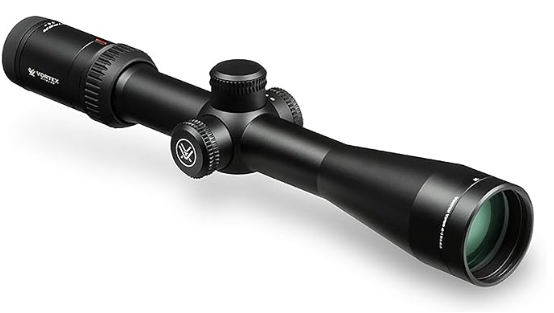
The Vortex Viper HS-T 6-24×50 with VMR-1 MRAD reticle occupies an interesting niche as the best Vortex mil dot scope for shooters who want MRAD capability but prefer second focal plane designs over FFP complexity. At approximately $700-900 depending on availability, this scope delivers premium Viper glass quality and excellent mechanical performance while maintaining the simpler, more traditional SFP approach that many precision shooters actually prefer for certain applications.
The 6-24x magnification range provides perfect power for long-range work from 300 to 1000+ yards, with low enough magnification for mid-range engagements and plenty of resolving power at 24x for extreme distance shooting.
What makes the HS-T worthy of consideration despite being second focal plane is the VMR-1 MRAD reticle design that’s specifically optimized for SFP use. The reticle features 0.5 MIL thick crosshair posts that draw the eye naturally to center, with hash marks providing holdover references that work beautifully when you’re shooting at maximum magnification where the reticle subtensions are accurate.
For shooters who dial elevation for distance and use reticle holds primarily for wind corrections, a common approach in F-Class and some precision disciplines, the SFP design actually offers advantages. The reticle stays the same apparent size regardless of magnification, which many shooters find less cluttered and easier to use than FFP reticles that shrink to near-invisibility at low power.
The optical quality is where the Viper HS-T genuinely excels and justifies its premium over Diamondback Tactical models. The XR fully multi-coated lenses deliver bright, clear images with excellent color fidelity and impressive contrast even in challenging conditions. The 50mm objective gathers substantial light, extending effective shooting time during marginal light periods.
At maximum magnification, the image remains sharp and usable for precision work rather than degrading into soft, low-contrast mush. When you’re trying to spot bullet impacts on steel at 800 yards or read environmental wind indicators, that optical quality makes a measurable difference in your ability to make good decisions and corrections.
The exposed tactical turrets offer 0.1 MRAD adjustments with excellent tactile and audible feedback, notably better than Diamondback Tactical turrets in feel and precision. Each click is distinct and positive, the turrets track reliably through their full adjustment range (19 MRAD elevation and windage), and the overall mechanical quality inspires confidence when you’re dialing multiple MRAD of adjustment for distance.
The turrets feature zero reset capability and maintain consistent feel even after thousands of adjustment cycles. At this price point, the mechanical quality represents excellent value for shooters who appreciate refined tactile feedback when operating turrets.
Key Features
| Feature | Specification |
|---|---|
| Magnification | 6-24x |
| Objective Lens | 50mm |
| Eye Relief | 4.0 inches |
| Field of View | 17.4-4.3 ft @ 100 yards |
| Tube Diameter | 30mm |
| Length | 15.0 inches |
| Weight | 22.6 oz |
| Reticle | VMR-1 MRAD (SFP) |
| Waterproof/Fogproof | Yes (Argon purged) |
| Warranty | VIP Unlimited Lifetime |
Pros
- Premium Viper glass quality delivers excellent clarity
- Second focal plane reticle stays constant size
- VMR-1 MRAD reticle optimized for SFP use
- Generous 4.0 inches eye relief provides comfort
- Refined turrets with precise 0.1 MRAD adjustments
- Lightweight at 22.6 ounces for tactical scope
- 50mm objective provides good light gathering
- Simpler than FFP for some shooting disciplines
Cons
- Reticle subtensions only accurate at maximum magnification
- Less versatile than FFP for tactical competitions
The Viper HS-T 6-24×50 MRAD serves shooters who appreciate MRAD systems but shoot primarily at fixed distances where they dial elevation and use reticle holds only for wind corrections. For F-Class competitors, benchrest precision shooters, or long-range hunters who prefer simpler SFP designs, this scope delivers premium optical quality and excellent mechanical performance.
Check Price on AmazonVortex Razor HD Gen II 4.5-27×56 EBR-2C MRAD (Best Premium Option)

For shooters demanding the absolute best Vortex mil dot scope regardless of cost, the Razor HD Gen II 4.5-27×56 with EBR-2C MRAD reticle represents Vortex’s flagship tactical optic that competes directly with scopes from Schmidt & Bender, Nightforce, and other premium manufacturers costing $3000-5000+.
At approximately $2400-2800 depending on configuration and sales, the Razor Gen II delivers optical excellence, mechanical perfection, and features that justify every dollar for serious competitors and professional users who demand equipment that never limits performance. The extended 4.5-27x magnification range provides incredible versatility from mid-range tactical shooting to extreme long-range precision work beyond 1500 yards.
What immediately sets the Razor HD apart is optical quality that crosses into genuinely exceptional territory. The HD (High Definition) glass uses premium extra-low dispersion elements that deliver images rivaling $4000+ European scopes in sharpness, color fidelity, and contrast. The APO (apochromatic) optical system virtually eliminates chromatic aberration even at extreme magnifications and challenging light angles.
The XR Plus fully multi-coated lenses maximize every photon of available light, creating images that remain bright, clear, and usable even during those critical twilight periods when most competitions conclude. At 27x maximum magnification, the optical performance remains consistent rather than degrading, you can actually use that top-end power for serious precision work rather than avoiding it because image quality falls apart.
The first focal plane EBR-2C MRAD reticle in the Razor represents reticle engineering perfected. The Christmas tree-style hash marks provide incredibly dense holdover points, 0.2 MIL graduations on the vertical crosshair and 0.5 MIL on the horizontal wind holds, enabling precise corrections without constant turret adjustments.
The floating center dot is just 0.03 MRAD, which is small enough to precisely engage tiny targets at extreme ranges without obscuring aim points. Reticle illumination features 11 brightness settings including several optimized for night vision use, though most daytime shooting happens with illumination off to maintain maximum contrast.
The exposed tactical turrets represent mechanical excellence that justifies premium pricing. The turrets offer tool-less zero reset, positive locking mechanisms, and adjustments that feel absolutely perfect, crisp, distinct clicks with zero slop or backlash. Adjustment range provides 27.5 MRAD elevation and 18.5 MRAD windage, which is generous enough for extreme long-range applications.
The turrets maintain consistent feel through tens of thousands of adjustment cycles, testament to manufacturing quality and materials far exceeding what most tactical scopes deliver.
Key Features
| Feature | Specification |
|---|---|
| Magnification | 4.5-27x |
| Objective Lens | 56mm |
| Eye Relief | 3.7 inches |
| Field of View | 23.2-4.4 ft @ 100 yards |
| Tube Diameter | 34mm |
| Length | 15.0 inches |
| Weight | 48.5 oz |
| Reticle | EBR-2C MRAD (FFP, Illuminated) |
| Waterproof/Fogproof | Yes (Argon purged) |
| Warranty | VIP Unlimited Lifetime |
Pros
- Exceptional HD glass rivals $4000+ European scopes
- Extended 4.5-27x magnification range
- Massive 56mm objective maximizes light gathering
- Premium EBR-2C MRAD reticle with 0.2 MIL graduations
- Turrets represent mechanical perfection
- 34mm tube provides maximum adjustment range
- Illuminated reticle with 11 settings
- Built for professional use and serious competition
Cons
- Heavy at 48.5 ounces requires robust mounting
- Complex reticle demands training to utilize fully
The Razor HD Gen II 4.5-27×56 justifies its position as the best Vortex mil dot scope for shooters who compete at the highest levels, professionals who depend on their equipment, or serious long-range enthusiasts who refuse to compromise on capability. If you’re shooting matches where equipment quality affects placements, engaging targets beyond 1000 yards regularly, or simply demand the absolute best regardless of cost, the Razor delivers performance worth its premium. For most shooters, the Viper PST Gen II provides 90% of this capability at 40% of the cost, making the Razor a specialized tool rather than general-purpose recommendation.
Check Price on AmazonVortex Strike Eagle 5-25×56 FFP (Best Value High-Magnification)

The Vortex Strike Eagle 5-25×56 FFP with EBR-7C MRAD reticle represents the best Vortex mil dot scope for shooters wanting maximum magnification range and large objective light gathering at an affordable price point. At approximately $600-750 depending on sales, this scope delivers 5-25x magnification and a massive 56mm objective, specifications typically found on scopes costing $1000-1500 while maintaining first focal plane MRAD functionality essential for tactical shooting.
The Strike Eagle occupies that interesting space between budget Diamondback Tactical models and premium Viper PST scopes, offering more magnification and light gathering than Diamondback while costing substantially less than PST.
The 5-25x magnification range with 25x maximum provides crucial capability for long-range shooting where you need resolving power to spot small targets at extreme distances or watch bullet trace for immediate shot corrections. The massive 56mm objective gathers substantially more light than standard 50mm objectives, extending effective shooting time during marginal light conditions.
For competitors shooting matches that run into late afternoon or shooters who practice during dawn and dusk periods, that extra light gathering provides genuine advantages in target visibility and clarity.
The first focal plane EBR-7C MRAD reticle is where the Strike Eagle delivers tactical capability at this price point. The Christmas tree-style hash marks provide dense holdover points for both elevation and windage, enabling fast target engagement without excessive turret dialing.
The FFP design maintains accurate subtensions at any magnification, critical for ranging and making holds throughout the power range. While the reticle isn’t quite as refined as EBR-2C in premium scopes, the lines are slightly thicker, the graduations slightly coarser—it’s entirely functional for tactical shooting and provides the features necessary for MRAD-based precision work.
Where the Strike Eagle makes compromises to hit its price point is optical quality and mechanical refinement. The glass is adequate rather than exceptional. Images are clear enough for precision shooting during good light conditions, but you’ll notice reduced contrast, less impressive edge sharpness, and diminished performance in challenging light compared to Viper or Razor scopes.
The turrets function reliably with 0.1 MRAD adjustments and adequate adjustment range, but the tactile feel isn’t as refined as premium scopes. There’s slightly more play, the clicks are less distinct, and the overall mechanical quality reflects the scope’s positioning as value-oriented rather than premium.
Key Features
| Feature | Specification |
|---|---|
| Magnification | 5-25x |
| Objective Lens | 56mm |
| Eye Relief | 3.7 inches |
| Field of View | 20.5-4.1 ft @ 100 yards |
| Tube Diameter | 30mm |
| Length | 15.7 inches |
| Weight | 27.3 oz |
| Reticle | EBR-7C MRAD (FFP, Illuminated) |
| Waterproof/Fogproof | Yes (Argon purged) |
| Warranty | VIP Unlimited Lifetime |
Pros
- Extended 25x maximum magnification
- Massive 56mm objective maximizes light gathering
- First focal plane EBR-7C MRAD reticle
- Outstanding value at $600-750 price point
- Illuminated reticle with multiple settings
- FFP functionality at accessible price
- 30mm tube provides adequate adjustment range
- VIP warranty protects investment
Cons
- Heavy at 27.3 ounces
- Image quality degrades in low light compared to premium scopes
The Strike Eagle 5-25×56 FFP serves shooters who want maximum magnification and light gathering for serious long-range work but can’t justify spending $1000+ on Viper PST or $2500+ on Razor scopes. For competitors on budgets, shooters building capable long-range rifles without unlimited funds, or anyone who values magnification range over ultimate optical refinement, this scope delivers functional capability that supports skill development and successful shooting. It’s the best Vortex mil dot scope for shooters who understand they’re prioritizing features over glass quality but still want equipment that genuinely works rather than just checking specification boxes.
Check Price on AmazonFrequently Asked Questions About Choosing Vortex Mil Dot Scopes
What’s the difference between mil dot and MRAD reticles?
“Mil dot” and “MRAD” essentially refer to the same measurement system, milliradians, but represent different reticle styles. Traditional mil dot reticles feature simple dots spaced at one-milliradian intervals on the crosshairs, providing basic ranging and holdover capability. Modern MRAD reticles (like Vortex’s EBR-2C or EBR-7C) use Christmas tree-style hash marks with much denser graduations, typically 0.2 or 0.5 MIL spacing, that provide more precise holdover points for both elevation and windage. Both use the milliradian measurement system where 0.1 MRAD equals approximately 1 centimeter at 100 meters or 3.6 inches at 100 yards. The key is ensuring your turrets match your reticle system—MRAD reticles should pair with MRAD turrets to avoid frustrating conversions.
Should I choose first focal plane or second focal plane for MRAD shooting?
First focal plane (FFP) is generally superior for tactical and competitive MRAD shooting because the reticle scales with magnification, maintaining accurate subtensions at any power setting. This means you can range targets, make wind holds, and use reticle measurements at 8x just as accurately as at 24x, critical versatility for dynamic shooting where you’re constantly adjusting magnification. Second focal plane (SFP) reticles stay the same apparent size but only provide accurate subtensions at maximum magnification. SFP works fine if you shoot at fixed distances, dial elevation, and primarily use the reticle for wind holds at max power. For PRS-style competitions, tactical shooting, or any application requiring reticle-based ranging and holdovers, FFP is worth the extra cost.
Why do tactical shooters prefer MRAD over MOA?
MRAD (milliradian) systems dominate tactical and competitive shooting because they work in base-10 decimals that make calculations faster and simpler under pressure. Military and law enforcement universally adopted MRAD because it enables easier communication of firing solutions, faster mental math for corrections, and simpler ranging calculations. When your dope says you need 3.4 MRAD of elevation, you simply dial 34 clicks (at 0.1 MRAD per click) without conversion math. MRAD also requires fewer clicks to make large corrections, approximately 3.44 times fewer than MOA—making turret adjustments faster. While MOA provides slightly finer adjustment granularity (1/4 MOA vs 0.1 MRAD), this precision difference rarely matters practically. The civilian competitive shooting world has followed military adoption, making MRAD the de facto standard for serious tactical applications.
What magnification range is best for MRAD tactical shooting?
The ideal magnification depends on your shooting distances and applications. For PRS-style competitions engaging targets from 300-1000 yards, a 5-25x or 6-24x range provides perfect versatility, low enough for mid-range shooting and situational awareness, powerful enough for extreme distance precision. For F-Class or benchrest shooting at known distances, 6-24x or even higher works well since you’ll shoot at maximum magnification. For 3-Gun or dynamic tactical shooting with closer engagement distances, a 1-6x or 1-8x LPVO with MRAD reticle handles 25-500 yard shooting better than high-magnification scopes. Most serious tactical shooters find 5-25x or 6-24x scopes provide the best balance between close-range capability and long-range precision for diverse shooting scenarios.
Do I need illuminated reticles for MRAD shooting?
Illuminated reticles provide genuine advantages in specific situations but aren’t essential for most tactical shooting. Illumination helps when shooting against dark backgrounds or in shadowed areas where the black reticle disappears into the target. It’s valuable for transitional light periods at dawn and dusk when the reticle might be hard to see against certain backgrounds. However, most precision tactical shooting happens with illumination off to maintain maximum contrast and reticle definition. If your shooting includes low-light scenarios, competitions that extend into twilight, or tactical applications where lighting varies dramatically, illumination justifies the modest cost premium. For range practice and daylight competitions, non-illuminated reticles work perfectly well and save money that’s better invested in ammunition and training.
How important is turret quality for MRAD tactical shooting?
Turret quality is absolutely critical for tactical shooting because you’re constantly dialing adjustments for distance and wind rather than using holdovers exclusively. Premium turrets like those on Viper PST Gen II or Razor scopes deliver crisp, distinct clicks with zero slop or backlash, track reliably through full adjustment range, and maintain consistent feel through tens of thousands of cycles. Budget turrets on Diamondback Tactical scopes function adequately but feel less refined with slightly mushy clicks and more mechanical play. For serious competition or precision work where you’re dialing multiple times per stage, premium turret quality genuinely improves shooting efficiency and confidence. For practice and training, budget turrets work fine and don’t limit skill development. Invest in turret quality proportional to your shooting frequency and competitive ambitions.
Conclusion
Choosing the best Vortex mil dot scope ultimately requires matching MRAD capabilities to your specific tactical shooting applications, competitive goals, and budget constraints. The MRAD system has earned its dominant position in tactical and long-range precision shooting through genuine advantages in calculation speed, communication simplicity, and universal adoption by serious shooters worldwide. Pairing this measurement system with quality Vortex optics that feature proper first focal plane designs, matching MRAD turrets, and appropriate magnification ranges creates rifle systems capable of precision that seemed impossible just decades ago.
The Vortex Viper PST Gen II 5-25×50 FFP stands as my top overall recommendation as the best Vortex mil dot scope for most serious tactical shooters. The combination of FFP MRAD reticle, premium optical quality, precise turrets, and $900-1200 pricing delivers capabilities that support successful competition shooting and skill development without requiring $2500+ investments. For budget-conscious shooters, the Diamondback Tactical 6-24×50 FFP proves you don’t need unlimited funds to access legitimate FFP MRAD functionality, at $400-500, it provides the essential features necessary for tactical shooting and competitive participation.
Shooters preferring second focal plane designs will find the Viper HS-T 6-24×50 MRAD delivers premium glass quality and refined mechanics for applications where SFP advantages outweigh FFP versatility. The Razor HD Gen II 4.5-27×56 represents the ultimate expression of tactical scope engineering for shooters demanding absolute excellence regardless of cost. The Strike Eagle 5-25×56 FFP fills that interesting gap where maximum magnification and light gathering meet accessible pricing for shooters prioritizing features over ultimate optical refinement.
Remember that even the finest MRAD scope delivers limited value without proper training and practice. Learn your reticle subtensions intimately, memorize the spacing, practice ranging known-distance targets, and develop wind-reading skills that let you effectively use holdover points. Practice dialing turrets until adjustments become automatic muscle memory. Shoot in varied conditions to understand how wind, mirage, and environmental factors affect your hits. The MRAD system provides tools that enable precision, but developing skills to use those tools effectively requires dedicated range time and deliberate practice.
The best Vortex mil dot scope isn’t determined solely by price or specifications, it’s whichever model matches your shooting applications, provides the features you’ll actually use, and fits within your budget while delivering quality that supports rather than limits your performance. Choose wisely based on your actual needs, practice diligently to master the MRAD