

Finding the best rifle borescope isn’t just about buying the most expensive option or the one with the flashiest marketing, it’s about understanding what actually matters for barrel inspection and matching those features to your specific needs as a shooter. After years of using multiple borescope models across dozens of rifles, from budget-friendly options to premium systems, I can tell you that the “best” borescope varies dramatically depending on whether you’re a casual hunter who cleans twice a year, a competition shooter monitoring barrel life, or a gunsmith inspecting client firearms daily.
The rifle borescope market has transformed dramatically over the past decade. What once required a $500-1000 investment in professional-grade equipment like Hawkeye systems is now accessible through quality digital borescopes starting around $50-70. This democratization of barrel inspection technology means every serious rifle owner can now see exactly what’s happening inside their barrels, verify cleaning effectiveness, diagnose accuracy problems, and inspect used firearms before purchase. But with dozens of options flooding the market, from established brands like Hawkeye and Lyman to newer players like Teslong, choosing the best rifle borescope requires understanding what features actually deliver value versus what’s just marketing hype.
Check out a detailed review on Teslong Borescope: Teslong Rifle Borescope Review
In this comprehensive guide, I’m breaking down exactly what makes the best rifle borescope for different users and budgets. We’ll cover the critical features that separate functional tools from frustrating gadgets, compare the leading models across different price tiers, explain what you can realistically expect to see and accomplish with each type of borescope, and help you make an informed decision based on your specific shooting needs and budget constraints. Whether you’re looking for the absolute best rifle borescope regardless of cost, the best value for money, or the best beginner-friendly option, you’ll find clear answers backed by real-world experience rather than regurgitated specifications.
What Makes the Best Rifle Borescope: Critical Features Explained

Before diving into specific product recommendations, you need to understand what actually matters in a rifle borescope. Marketing materials throw around impressive-sounding specifications that often don’t translate to practical value, while critical features get buried in technical jargon. Here’s what truly separates the best rifle borescope options from mediocre ones.
Image Quality and Resolution is obviously critical. If you can’t clearly see carbon fouling, copper deposits, throat erosion, or pitting, the borescope is useless regardless of other features. However, the relationship between resolution specifications and actual useful image quality is more complex than higher numbers always being better. Many borescopes advertise 1080p or even higher resolutions, but you’re viewing through a tiny camera lens positioned inside a dark, curved steel tube. The practical limitations mean that the best rifle borescope in terms of actual visible detail often comes down to lens quality, LED lighting effectiveness, and focal distance rather than just pixel count.
What you actually need is image clarity sufficient to distinguish between carbon fouling (appears dark, sometimes crusty), copper fouling (bronze to reddish-brown with metallic sheen), throat erosion (roughened, cratered surfaces), fire-cracking (alligator-skin cracking patterns), and general barrel condition. The best rifle borescope delivers this level of detail consistently across different barrel types, whether you’re inspecting a polished stainless custom barrel or a rougher chrome-moly factory barrel.
Probe Design and Length fundamentally affects what you can inspect and how easily you can do it. Rigid probes offer precise control and easy rotation for systematic inspection—you can position them exactly where you want and smoothly scan the entire circumference of the bore. The best rigid probe lengths for rifle inspection typically range from 26 inches (handles most standard rifles) to 36 inches (covers long barrels). Flexible probes sacrifice some positioning control but offer versatility for inspecting very long barrels, working around obstacles, and non-gun applications. The best rifle borescope for most users typically features a semi-rigid or flexible design with enough stiffness to push through a barrel without collapsing.
Probe diameter is equally critical—too large and it won’t fit in smaller calibers, too small and you’re limited to miniature firearms. The sweet spot for rifle applications is 0.2 inches (5mm), which fits .20 caliber and larger. This covers everything from .223 Remington up through large magnum cartridges. Smaller diameter probes exist for .17 caliber rifles, but they’re specialized tools rather than general-purpose instruments.

Lighting System Quality makes an enormous difference in barrel inspection effectiveness. Inside a rifle barrel is pitch black—without adequate illumination, you see nothing regardless of camera quality. The best rifle borescope features adjustable LED ring lights (typically 6 LEDs arranged around the camera lens) with sufficient brightness range to handle both heavily fouled barrels requiring maximum illumination and polished stainless barrels where too much light creates glare washing out details. Cheap borescopes often feature weak LEDs or fixed-brightness lighting that limits their practical effectiveness in different barrel conditions.
Side-View Mirror System is absolutely essential for rifle barrel inspection and separates dedicated rifle borescopes from generic inspection cameras. Looking straight down the bore axis shows you the chamber end or muzzle but doesn’t reveal the barrel walls where fouling accumulates and erosion occurs. The best rifle borescope includes caliber-specific mirrors (typically .22, .30, and .38 caliber sizes) that position the camera at the optimal distance from the barrel wall and provide that crucial side-view perspective showing rifling in profile. This is how you actually see carbon buildup in the grooves, copper streaking on the lands, carbon rings at the throat, and other conditions that matter for barrel maintenance and diagnostics.
Connectivity Options define usability and convenience. USB-connected borescopes plug directly into computers, Android phones, or tablets, offering simplicity and lag-free video transmission. WiFi-connected models provide wireless operation but can suffer from connection stability issues and compatibility problems. Stand-alone systems with built-in screens eliminate device compatibility concerns entirely, turn on the screen, plug in the probe, start inspecting. The best rifle borescope for your needs depends on your comfort with technology and whether you prefer using existing devices or having a dedicated tool.

Build Quality and Durability separates tools that last years from ones that fail after a few uses. The best rifle borescope features robust probe construction (usually stainless steel), quality camera lens protection, reliable cable connections, and overall engineering that handles regular use in garage workshop conditions. This is where premium brands justify their higher prices—a $600 Hawkeye borescope will outlast multiple budget models if you’re using it professionally. For occasional home use, quality budget models can provide years of service with careful handling.
Comparison Table: Best Rifle Borescopes 2025
| Model | Price Range | Probe Type | Length | Screen | Best For | Image Quality | Key Feature |
|---|---|---|---|---|---|---|---|
| Teslong NTG100H | $50-70 | Rigid | 26″ | USB (Phone/PC) | Budget beginners | 720p | Best entry-level value |
| Teslong NTG450H | $130-150 | Rigid | 26″ | 4.5″ Built-in | Recreational shooters | 1080p | Sweet spot choice |
| Teslong NTG100 Flexible | $60-80 | Flexible | 45″ | USB (Phone/PC) | Long barrels/diverse collection | 720p | Maximum versatility |
| Lyman Borecam | $200-250 | Rigid | 20″ | 2.4″ Built-in | Brand-loyal buyers | 640×480 | American brand |
| Hawkeye V2 Slim | $500-1000+ | Flexible | 17-36″ | Optical eyepiece | Professional gunsmiths | Fiber-optic (superior) | Professional-grade durability |
The Best Rifle Borescope for Budget-Conscious Shooters:
Teslong Options

If you’re looking for the best rifle borescope that doesn’t require a huge investment, the Teslong lineup dominates this category through impressive value propositions. These Chinese-manufactured borescopes have revolutionized the market by offering surprisingly good image quality and functionality at prices ranging from $50-70 for basic USB-connected models up to $150-200 for premium stand-alone systems with built-in screens.
Teslong NTG100H rigid rifle borescope

This represents the best entry point for shooters wanting to experiment with barrel inspection without significant financial commitment.
At approximately $50-70 depending on sales, this model features a 26-inch rigid stainless steel probe with 0.2-inch diameter fitting .20 caliber and larger barrels.
The USB connectivity works with Windows PCs, Mac computers, and Android smartphones/tablets (not iPhone/iPad natively—Apple device compatibility requires WiFi models or adapters). Image quality provides 720p resolution that’s more than adequate for identifying carbon fouling, copper deposits, throat erosion, and general barrel condition.
What makes this the best rifle borescope for budget-conscious users isn’t just the low price it’s that you’re not sacrificing essential functionality to save money.
The included side-view mirrors (.22, .30, .38 caliber) work well, the six adjustable LED lights provide adequate illumination, and the image quality genuinely allows you to see what you need to see. Yes, the optical quality doesn’t match $600 Hawkeye systems, but it shows you whether your barrel is clean, where fouling accumulates, and how your throat is wearing. For most recreational shooters and hunters, that’s exactly what matters.
Teslong NTG450H with 4.5-inch stand-alone screen
It is widely considered the best rifle borescope in the mid-budget category at approximately $130-150. This complete system eliminates smartphone/computer requirements with a dedicated 4.5-inch LCD screen that’s bright, clear, and completely self-contained.
The rigid probe offers precise positioning control, the 32GB memory card provides ample storage for photos and videos, and the rechargeable battery delivers 3-4 hours of continuous use. The stand-alone convenience makes this setup particularly appealing for shooters who want tools that just work without technology hassles.
Having personally used multiple Teslong models extensively, I can confidently say they deliver far more value than their prices suggest. Are they perfect? No. The mirrors are somewhat delicate. The fixed focus on most models requires learning the optimal positioning distance. The connectivity on WiFi models can be finicky. But as the best rifle borescope for shooters working within budget constraints, Teslong products have legitimately changed the game.
Premium Choice:
Why Hawkeye Remains the Best Rifle Borescope for Professionals
Despite the explosion of affordable digital borescopes, Hawkeye systems from Gradient Lens Corporation retain their position as the best rifle borescope for professional gunsmiths, serious competition shooters, and users who demand absolute optical excellence regardless of cost. Priced from $500 for basic models up to $1000+ for complete kits with angled eyepieces and accessories, Hawkeye borescopes represent the premium tier where optical quality, build longevity, and professional-grade performance justify the substantial investment.
What makes Hawkeye the best rifle borescope for professional applications starts with optical quality that’s genuinely superior.
These are fiber-optic instruments manufactured by a company specializing in medical-grade endoscopes, not consumer electronics companies repurposing inspection cameras. The image clarity, color accuracy, and sharpness exceed digital borescopes at comparable magnifications.
When you look through a Hawkeye, fine details like shallow pitting, light copper streaking, or early-stage throat erosion become clearly visible where budget borescopes might miss them.
Hawkeye V2 Slim

Represents the modern iteration of the classic Hawkeye design, featuring a flexible probe in various lengths from 17 inches up to longer options for different barrel applications.
The probe diameter at 0.175 inches fits .22 caliber and larger firearms. The optical system delivers exceptional depth of field, allowing you to focus on surfaces without constant adjustment. The angled eyepiece (essential accessory in my opinion) makes inspection more comfortable since you’re not hunching directly over the rifle bore.
The entire system is built to professional standards designed for daily commercial use by gunsmiths rather than occasional hobby use.
Where Hawkeye justifies its position as the best rifle borescope for professionals is durability and longevity. These instruments last decades with proper care. I know gunsmiths still using Hawkeye borescopes purchased 15-20 years ago that function as well as new units.
The construction quality, materials, and engineering are simply on a different level than consumer-grade digital borescopes. For professional use where the tool generates income and must perform reliably day after day, this durability has real value.
The major disadvantage of Hawkeye as the best rifle borescope is that it’s purely optical, no photo or video capture capability without adding expensive camera adapters that push total system costs over $2000. You’re looking directly through an eyepiece seeing a live optical image, which is both a strength (no digital artifacts, no lag, perfect real-time viewing) and limitation (can’t save images, can’t share what you’re seeing with others easily).
For home users wanting to document barrel condition or compare before/after cleaning results, this is a significant drawback that makes digital borescopes more practical despite inferior optical quality.
Check Price on AmazonThe Middle Ground:
Lyman Borescope Analysis

The Lyman Borecam occupied an interesting position as the best rifle borescope in the mid-tier market before Teslong disrupted pricing structures. At approximately $200-250, the Lyman delivered digital borescope capability with a built-in screen at a price point below premium Hawkeye systems but above bare-bones inspection cameras.
Today, Lyman faces intense competition from better-featured Teslong models at similar or lower prices, raising questions about whether it still represents the best rifle borescope value in its price category.
Lyman Borecam
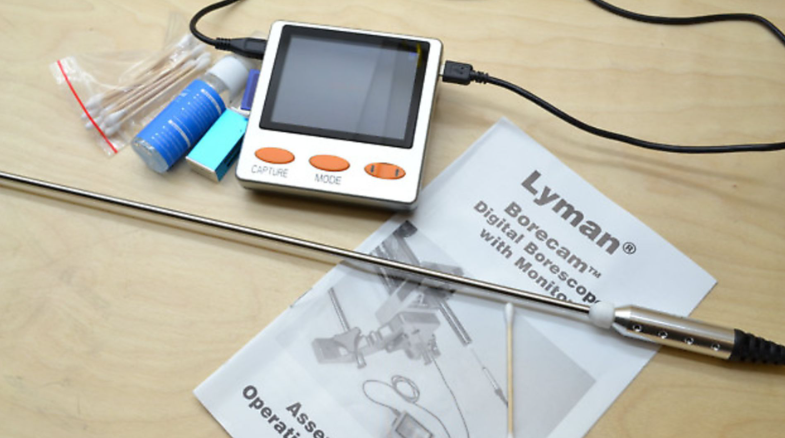
This features a 20-inch rigid probe with 0.2-inch diameter, a built-in 2.4-inch display screen, and 640×480 pixel resolution. The system captures still images and video to an SD card, includes a 90-degree mirror for side-view inspection, and operates as a complete stand-alone unit requiring no computer or smartphone. Build quality is reasonable with hard-case storage, and the rigid probe provides decent positioning control for systematic barrel inspection.
Where Lyman struggles to maintain its position as a contender for the best rifle borescope is that Teslong has essentially matched or exceeded its capabilities while undercutting on price. The Teslong NTG450H offers a larger 4.5-inch screen, arguably better image quality, similar rigid probe design, and comparable features for $130-150—roughly 30-40% less than Lyman’s typical pricing.
User reviews consistently note that Teslong image quality equals or exceeds Lyman despite lower cost.
However, Lyman still has defenders who appreciate the brand’s American presence, customer service reputation, and optical characteristics that some users find superior for certain inspection tasks like identifying lead fouling in rimfire barrels.
The debate over whether Lyman or Teslong represents the best rifle borescope in the $150-250 range ultimately comes down to personal preferences about brand trust versus pure value optimization.
My honest assessment after using both extensively: unless you have specific loyalty to Lyman or find a great sale price, Teslong’s stand-alone systems offer better value as the best rifle borescope for most users in this price category.
The superior screen size, comparable image quality, and lower cost make Teslong the logical choice for budget-conscious buyers, reserving the Lyman as an option for users who prefer American brands or have had positive past experiences with Lyman products.
Check Price on AmazonFlexible vs. Rigid Probes: Which Is Best?
One of the most common questions when choosing the best rifle borescope is whether flexible or rigid probes better serve rifle inspection needs. The answer depends on your specific use cases, but understanding the trade-offs helps you make informed decisions.
Rigid probes (typically 26 inches long) excel at precise, controlled barrel inspection. The solid stainless steel construction allows you to position the camera exactly where you want it and smoothly rotate through 360 degrees to systematically inspect the entire bore circumference.
This controlled movement makes it easier to study specific areas of interest, you can hold steady on a suspect area, carefully examine throat condition, or precisely compare different sections of the barrel. The rigid design also tends to be more durable since there’s no flexible cable that can kink or develop weak points.
The limitation of rigid probes is length. 26 inches handles most sporting rifles, AR-15s, and hunting guns, but very long barrels (30+ inches) won’t be inspected completely from one end. You’ll need to inspect from both muzzle and chamber to see the entire barrel, or upgrade to longer flexible probes. For standard hunting rifles and tactical firearms, this isn’t typically problematic, which is why many users consider rigid probe models the best rifle borescope for their specific needs.
Flexible probes (typically 36-45 inches long) provide versatility that rigid probes can’t match. The semi-rigid cable has enough stiffness to push through rifle barrels without collapsing but can bend around obstructions and inspect very long barrels completely from muzzle to chamber in one pass. This makes flexible probes particularly valuable for precision shooters with long-barrel competition rifles, for gunsmiths who see diverse firearms daily, and for users who want one tool that handles any rifle regardless of barrel length.
The trade-off is less precise positioning control. The flexible cable doesn’t provide the same stable, controlled rotation as rigid probes, making systematic inspection slightly more challenging. You can absolutely accomplish the same inspection tasks, but it requires a bit more practice and patience. For many users, this minor inconvenience is worth accepting to gain the versatility of inspecting any barrel length, which is why flexible probe models often earn recommendations as the best rifle borescope for users with diverse firearm collections.
My personal recommendation based on extensive experience with both: if you primarily shoot standard-length rifles (16-26 inch barrels) and value precise, controlled inspection, rigid probe models represent the best rifle borescope choice. If you shoot precision rifles with long barrels, own diverse firearms ranging from pistols to long-barreled rifles, or want maximum versatility, flexible probe models are the best rifle borescope option despite their slightly less controlled handling.
Stand-Alone Screen vs. Smartphone Connectivity: What’s Best?

The debate between stand-alone borescope systems versus smartphone-connected models significantly impacts user experience and helps determine which is the best rifle borescope for your specific preferences and technical comfort level.
Stand-alone screen systems like the Teslong NTG450H or NTG500H represent what many users consider the best rifle borescope approach for practical reasons. These complete packages include dedicated LCD screens (4.5 or 5 inches), built-in rechargeable batteries, integrated memory cards, and simple controls. Turn on the screen, connect the probe, adjust LED brightness, and start inspecting, no apps to download, no WiFi to configure, no device compatibility concerns. The screens are bright enough for use in garage conditions, battery life supports multiple inspection sessions, and everything stays organized in one carrying case.
The stand-alone approach appeals particularly to shooters who aren’t technology enthusiasts, older users who struggle with smartphone apps, and anyone who wants tools that simply work every time without troubleshooting connectivity issues. If your phone rings during barrel inspection, your borescope screen doesn’t interrupt. If you upgrade your phone, your borescope doesn’t become incompatible. If you’re working in an area with poor WiFi signal, your stand-alone system doesn’t care. This reliability and simplicity makes stand-alone systems compelling as the best rifle borescope for many users.
The trade-off is carrying a dedicated device rather than leveraging technology you already own. For some users, this feels redundant when they carry smartphones everywhere anyway. The screens, while adequate, are smaller than most modern smartphones. And stand-alone systems cost more than equivalent USB-connected models since you’re paying for the screen, battery, and integrated electronics.
Smartphone-connected borescopes (USB or WiFi) leverage devices you already own, potentially offering larger screens, easier file sharing, and lower equipment costs. USB models like the basic Teslong NTG100H connect directly to Android phones, tablets, and computers for viewing, providing lag-free video transmission and reliable operation. The lower cost makes these appealing as the best rifle borescope for budget-conscious users or those comfortable with technology.
WiFi models add wireless convenience but introduce potential connectivity frustrations—pairing issues, connection dropouts, compatibility problems with certain devices, and battery management in the probe. While wireless operation sounds convenient, many users report that these connectivity hassles make WiFi models less desirable as the best rifle borescope choice compared to reliable USB or stand-alone alternatives.
Apple device users face particular challenges since iPhones and iPads don’t support USB camera devices natively. You’ll need WiFi-enabled borescopes for iPhone compatibility, accepting the connectivity trade-offs that come with wireless operation. This limits what many iOS users can consider as the best rifle borescope options.
My recommendation after extensive experience with multiple connectivity approaches: stand-alone screen systems represent the best rifle borescope choice for most users despite higher initial cost. The convenience, reliability, and frustration-free operation justify the premium. However, if you’re tech-savvy, comfortable troubleshooting connectivity issues, and want to minimize cost, USB-connected models work perfectly well and might be the best rifle borescope for your specific situation.
What the Best Rifle Borescope Actually Shows You

Understanding realistic expectations helps you evaluate which is the best rifle borescope for your needs. Marketing materials often show pristine images that don’t reflect what you’ll actually see inspecting real-world barrels under typical conditions.
Carbon fouling appears as dark, sooty deposits in the grooves between lands. Light carbon buildup looks like thin dark streaks. Heavy carbon buildup appears crusty and textured, sometimes almost black against the steel. The best rifle borescope makes carbon clearly visible as darker material distinct from the barrel steel. Carbon rings at the throat show up as pronounced bands of heavy black deposit right where the bullet engages the rifling—these are unmistakable once you know what you’re looking for.
Copper fouling displays as bronze to reddish-brown streaks or patches with distinctive metallic sheen under LED illumination. The exact color varies depending on how thick the copper buildup is and the LED brightness settings. Light copper fouling might appear as bronze-colored streaks in the grooves. Heavy copper buildup looks like thick bronze plating on the lands. The best rifle borescope for copper detection provides sufficient light control to avoid washing out the copper’s metallic appearance while still illuminating the bore adequately.
Throat erosion manifests as roughened, cratered surfaces at the beginning of the lands where hot powder gases and bullet friction gradually wear the steel. Early-stage erosion appears as slight roughening. Advanced erosion shows distinct cratering, sometimes with fire-cracking (alligator-skin cracking patterns from heat stress). The best rifle borescope reveals this progressive damage, allowing you to document throat condition over time and make informed barrel replacement decisions.
Pitting from corrosion appears as small holes or craters in the barrel surface, usually darker than surrounding steel. Shallow pitting might look like small dark spots. Deep pitting appears as obvious holes that cast shadows under side lighting. The best rifle borescope illuminates these defects clearly, though extremely shallow pitting might require multiple viewing angles to identify definitively.
Tool marks and machining imperfections from manufacturing are visible in most barrels under magnification and often alarm new borescope users who don’t realize these are normal. Even premium custom barrels show some machining marks, slight roughness, or surface variations when viewed at high magnification. The best rifle borescope helps you distinguish between normal manufacturing characteristics and actual problems requiring attention—a learning process that takes comparing multiple barrels and studying online examples.
What you won’t get from even the best rifle borescope is perfect, magazine-quality imagery like professional gunsmithing publications. There will be some edge softness, color variations depending on lighting, and occasional glare in polished sections. But the practical reality is that the best rifle borescope doesn’t need perfect imagery—it needs clarity sufficient to assess barrel condition, verify cleaning effectiveness, identify problems, and make informed maintenance decisions.
What You’re Actually Seeing: Interpreting Borescope Images

Your first barrel inspection might leave you wondering if what you’re seeing is normal or problematic. Here’s how to interpret common conditions.
Carbon Fouling
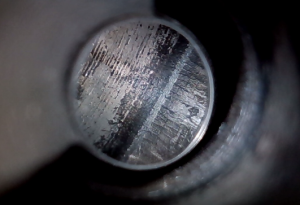
Appearance: Dark gray to black deposits, often with a sooty or crusty texture
Location: Accumulates in the grooves between lands, with heavy buildups at the throat
Normal or problem? Some carbon is normal after shooting. Heavy, crusty buildup indicates inadequate cleaning. Carbon rings at the throat (thick black bands right where rifling begins) suggest serious cleaning deficiency.
What to do: Clean the barrel and inspect again to verify removal
Copper Fouling
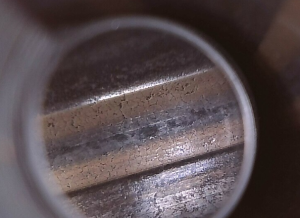
Appearance: Bronze to reddish-brown streaks or patches with metallic sheen under LED light
Location: Typically appears on the lands (raised portions) and in the throat area
Normal or problem? Light copper streaking is normal and appears quickly during shooting. Heavy copper buildup (thick bronze coating) indicates either inadequate cleaning or a rough barrel that fouls excessively.
What to do: Use copper solvent and clean until borescope shows removal
Throat Erosion

Appearance: Roughened, cratered surface at the beginning of the lands, sometimes with alligator-skin cracking (fire-cracking)
Location: First 1-3 inches of rifling where hot powder gas and bullet friction cause wear
Normal or problem? All barrels erode gradually. Light roughening after thousands of rounds is normal. Heavy cratering, deep fire-cracking, or erosion extending several inches into the barrel indicates significant wear requiring monitoring.
What to do: Document with photos and track progression. Consider barrel replacement when erosion affects accuracy.
Tool Marks and Machining

Appearance: Fine lines, slight roughness, or surface variations running lengthwise
Location: Visible throughout the barrel, sometimes more prominent in certain areas
Normal or problem? Completely normal. Even premium custom barrels show some machining marks under magnification. This is manufacturing reality, not a defect.
What to do: Nothing. These are normal characteristics.
Pitting and Corrosion

Appearance: Small holes or craters in the barrel surface, usually darker than surrounding steel
Location: Can appear anywhere but often concentrated in specific areas
Normal or problem? Never normal. Pitting indicates corrosion from moisture, improper storage, or corrosive ammunition residue.
What to do: Shallow pitting may not affect accuracy. Deep or extensive pitting requires professional evaluation and possible barrel replacement.
Troubleshooting Common Issues
“I can’t see anything, just darkness”
Solutions:
- Verify LEDs are turned on and brightness is adequate
- Check that your mirror is installed and facing the correct direction
- Ensure the probe is actually inside the barrel far enough for the mirror to be positioned in the bore
- Clean the camera lens window, it might be dirty or fogged
“Everything looks blurry or out of focus”
Solutions:
- Most budget borescopes have fixed focus requiring specific positioning distance from the barrel wall
- Adjust how far the probe is inserted to find the optimal focal distance
- Clean the camera lens and mirror thoroughly
- For optical Hawkeye systems, adjust the eyepiece focus
“The image is too bright/washed out”
Solutions:
- Reduce LED brightness significantly
- Polished stainless barrels reflect more light than chrome-moly, requiring lower settings
- Try positioning the probe at different distances from the barrel wall
“I see weird colors or patterns that don’t look like a barrel”
Solutions:
- Verify the mirror is installed correctly and facing outward
- Check that the probe is centered in the bore, not pressing against the rifling
- Ensure the mirror is clean on both sides
- You might be viewing the chamber or muzzle, advance or retract the probe
“The probe won’t fit in my barrel”
Solutions:
- Verify you’re using a borescope with appropriate diameter (0.2″ fits .20 caliber and larger)
- Remove the mirror and try inserting just the probe to determine if the mirror or probe is too large
- Check that you’re not trying to force the probe past an obstruction in the barrel
- Some very small calibers (.17 HMR, etc.) require specialized smaller-diameter borescopes
How to Choose the Best Rifle Borescope for Your Needs

After covering features, price tiers, and realistic expectations, let’s synthesize this information into practical decision-making guidance based on your specific shooting profile and requirements.
For hunters and recreational shooters who clean rifles occasionally (2-4 times per year) and want to verify cleaning effectiveness, the best rifle borescope is typically a mid-budget stand-alone system like the Teslong NTG450H. The $130-150 investment provides complete functionality with convenient stand-alone operation, the 26-inch rigid probe handles most hunting rifle barrels, and image quality is more than adequate for monitoring barrel condition and confirming thorough cleaning.
This level represents the sweet spot of capability versus investment for users who want visual barrel inspection without professional-grade equipment.
For competition shooters and precision rifle enthusiasts who monitor barrel life carefully, shoot high round counts, and need to track throat erosion progression, the best rifle borescope might be either a premium Teslong system with extended probe length (like the NTG100 flexible 45-inch model for about $60-80) or stepping up to professional Hawkeye systems ($500+) if budget allows and optical excellence matters more than cost.
The longer probe ensures complete barrel inspection in long-barreled competition rifles, and the ability to document throat condition photographically helps track wear over time. Serious competitors often consider this essential equipment rather than optional luxury.
For gunsmiths and professional firearm services, the best rifle borescope is unquestionably Hawkeye systems despite their premium pricing. The superior optical quality, professional-grade durability designed for daily commercial use, and longevity that provides decades of service justify the investment when the tool generates income.
The ability to confidently assess barrel condition for clients, diagnose accuracy problems accurately, and provide professional services backed by premium equipment makes Hawkeye worth its cost in professional applications.
For budget-conscious shooters experimenting with barrel inspection or building basic rifle maintenance capabilities, the best rifle borescope is the Teslong NTG100H rigid USB model at approximately $50-70. This entry-level investment delivers genuine functionality—you can see carbon fouling, copper deposits, throat condition, and general barrel state clearly enough to improve cleaning effectiveness and understand barrel condition.
If you discover borescope inspection isn’t valuable for your needs, you’ve risked minimal investment. If it transforms your maintenance approach (likely), you can upgrade to stand-alone systems later while keeping this as a backup.
For shooters with diverse firearm collections including rifles, pistols, and various barrel lengths, the best rifle borescope might be the Teslong NTG100 flexible 45-inch probe (about $60-80) for maximum versatility. The flexible design accommodates any barrel length from compact pistols to long-barreled precision rifles, and the 0.2-inch diameter fits .20 caliber and larger.
While you sacrifice some of the precise control of rigid probes, you gain one tool that handles your entire collection rather than needing multiple specialized borescopes.
Common Mistakes When Buying Your First Borescope
Understanding frequent buyer errors helps you avoid choosing the wrong tool as your “best rifle borescope” only to discover it doesn’t meet your actual needs.
Mistake 1: Buying the cheapest option without verifying rifle-specific features. Generic industrial inspection cameras or ultra-budget endoscopes lack the side-view mirrors, appropriate focal distances, and feature sets needed for rifle barrel inspection. You’ll save $20-30 but end up with a tool that shows you the chamber or muzzle without revealing the barrel walls where fouling accumulates. The best rifle borescope investment requires spending enough to get actual rifle-specific functionality.
Mistake 2: Overbuying premium features you won’t use. A $600 Hawkeye system delivers exceptional optical quality, but if you’re a recreational hunter cleaning your rifle three times per year, that optical superiority doesn’t provide practical value justifying the cost. The best rifle borescope for your needs matches capability to usage, premium equipment for professional use, value-focused equipment for occasional home use.
Mistake 3: Prioritizing WiFi connectivity without understanding the trade-offs. Wireless operation sounds convenient until you experience connection dropouts, pairing problems, and compatibility issues that plague many WiFi borescopes. The best rifle borescope often uses simple, reliable USB connection or stand-alone screens rather than adding wireless complexity that creates frustration.
Mistake 4: Buying rigid probes too short for your rifles. If you shoot long-barreled precision rifles or magnum hunting guns with 26+ inch barrels, a 26-inch rigid probe won’t inspect the full length. You’ll need flexible probes or longer rigid options. The best rifle borescope for your specific firearms matches probe length to your longest barrels.
Mistake 5: Not verifying device compatibility. iPhone/iPad users often buy USB borescopes expecting them to work with Apple devices, only to discover iOS doesn’t support USB cameras. Verify compatibility with your devices before purchasing, or choose stand-alone systems that eliminate this concern entirely.
Common Beginner Mistakes (And How to Avoid Them)
Mistake 1: Inspecting Immediately After Cleaning
Your barrel is wet with solvent and oil, creating reflections and streaks that obscure actual barrel condition. Wait 10-15 minutes after final patches for the barrel to dry, or run one dry patch before borescope inspection.
Mistake 2: Using Too Much Light
Cranking LED brightness to maximum often washes out details, especially in polished stainless barrels. Start at 50% brightness and adjust based on what you see. Sometimes less light reveals more detail.
Mistake 3: Moving Too Fast
Rushing through barrel inspection means missing important details. Slow, systematic inspection with regular rotation reveals far more than quick passes through the bore.
Mistake 4: Forgetting the Mirror
This seems obvious, but beginners often insert the probe without the mirror attached or with the mirror facing the wrong direction. No mirror means no useful barrel inspection.
Mistake 5: Panicking at Normal Features
First-time users often mistake normal machining marks, light copper fouling, or minor throat roughness for serious problems. Compare your findings to online examples and reference images before assuming disaster.
Mistake 6: Scratching the Crown
The most expensive beginner mistake is dragging a metal probe across the precision-machined muzzle crown. Always use protective guides.
Maintaining Your Borescope Investment

Even the best rifle borescope requires proper care to maintain functionality and longevity. These tools are precision instruments with delicate components that don’t tolerate abuse.
Clean the probe and mirrors before and after each use. Fouling from previous inspections creates false images showing every barrel as dirty. Use isopropyl alcohol and soft microfiber cloths to keep the camera lens window, LED covers, and mirrors spotlessly clean. The mirrors are particularly delicate, clean gently rather than scrubbing aggressively.
Store properly in provided cases. The best rifle borescope in the world is worthless if you break it by careless storage. Use the fitted foam cases included with most models to protect probes from impacts and mirrors from damage. Coil flexible probes loosely rather than tight kinks that stress the cable.
Avoid getting solvents on electronic components. While probes are typically rated waterproof or water-resistant for cleaning, avoid submerging electronic connections or allowing harsh gun cleaning solvents to contact anything beyond the probe tip. Chemical damage to seals or electronics isn’t covered by most warranties.
Check connections periodically. The threaded connections between probes and display units can loosen over time. Verify they’re snug before each use to avoid connection issues during inspection.
Check out Teslong Rifle Borescope Review in details
Conclusion: What’s the Best Rifle Borescope?
After this extensive analysis of features, brands, price tiers, and user needs, what’s the definitive answer to “what’s the best rifle borescope?” The honest answer is: it depends on your specific requirements, budget, and shooting profile.
For most recreational shooters and hunters, the Teslong NTG450H stand-alone system represents the best rifle borescope choice. The $130-150 price point delivers complete functionality with convenient stand-alone operation, the rigid probe provides precise inspection control, image quality clearly shows everything you need to see for maintenance and diagnostics, and the system just works reliably without technology hassles. This is the sweet spot where capability meets value for the largest segment of rifle owners.
For professional gunsmiths and serious competition shooters who demand absolute optical excellence and professional-grade durability, Hawkeye systems remain the best rifle borescope despite premium pricing. The superior image quality, robust construction, and decades-long service life justify the investment in commercial applications.
For budget-conscious shooters wanting to experiment with barrel inspection, the Teslong NTG100H rigid USB model at $50-70 delivers the best rifle borescope value in the entry-level tier. You’re getting genuine functionality that transforms barrel maintenance at minimal cost.
The transformation that comes from visual barrel inspection, moving from blind cleaning based on hope to evidence-based maintenance justifies investing in the best rifle borescope you can afford. Whether that’s a $60 entry-level model or a $600 professional system, the knowledge gained from actually seeing inside your barrels pays dividends in improved accuracy, extended barrel life, and confidence in your equipment condition.
Stop cleaning blind. Get the best rifle borescope for your needs and see the truth about what’s happening inside your barrels.