
Here is something most buyers do not realize at first: thermal imaging does not rely on any ambient light whatsoever. It detects the heat signatures that all living things and many inanimate objects naturally emit. That means a zero-lux environment, heavy brush, light fog, and even most dust and smoke are far less of an obstacle than they would be for night-vision or standard daytime optics.
The technology was originally developed for military and law enforcement use and has steadily dropped in price over the past decade, putting genuinely capable units within reach of serious hunters and outdoor enthusiasts.
The core specs to understand before buying are resolution (the sensor size, measured in pixels), refresh rate (measured in hertz, with 50 Hz being noticeably smoother than 25 Hz), detection range (how far out the unit can spot a person-sized heat signature), and the lens focal length, which determines magnification and field of view.
Premium units pair all of these with ergonomic handheld designs, rechargeable batteries, and onboard recording. Budget units make trade-offs, and it is important to know exactly where those trade-offs land before you spend your money.
In this guide we have tested and evaluated five of the best thermal binoculars available right now across different price points and use cases. Whether you want the best overall performer, the most budget-friendly entry point, or the longest detection range money can buy, there is something on this list for you. Let us get into it.
Below are our top five picks, ranked by overall performance and value:
Top 5 Best Thermal Binoculars
1. Pulsar Merger LRF XP50-Best Overall Thermal Binoculars
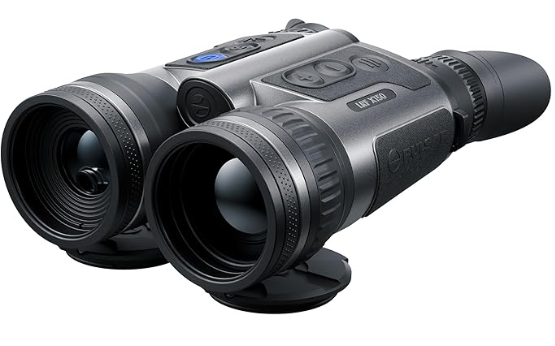
If you want to know what the current gold standard in handheld thermal binoculars looks like for civilian use, the Pulsar Merger LRF XP50 is it. Pulsar has earned a near-legendary reputation among serious hunters and military-adjacent professionals for building optics that genuinely deliver, and the Merger XP50 is the clearest evidence of that yet.
What sets it apart immediately is the combination of a 640×480 thermal sensor with a 17-micron pixel pitch, which translates to image clarity that still surprises experienced thermal users. You can clearly identify the body shape and gait of an animal at distances that would reduce lesser units to a blob of heat.
The built-in laser rangefinder is not a gimmick here. It is accurate and fast, giving you a confirmed distance readout without needing to carry a separate unit. The ergonomics are excellent for a device in this category. It is a true binocular design with dual eyepieces rather than a monocular with a second barrel added for looks, and both channels deliver a sharp, synchronized image. Battery life runs to about eight hours with the internal lithium-ion pack, and you can swap in an external B-pack for extended all-night sessions.
The 50 Hz refresh rate ensures the image stays smooth when you pan or when the animal moves, which is a subtle but meaningful comfort advantage during long glassing sessions. It also connects to the Pulsar Stream Vision app via Wi-Fi for video recording and streaming to your phone, which is useful for scouting documentation. The detection range sits at around 1,800 meters for a person-sized target. At this price, the Merger XP50 competes with units costing considerably more.
| Feature | Specification |
|---|---|
| Sensor Resolution | 640 x 480, 17 μm pixel pitch |
| Magnification | 2.5x to 20x |
| Refresh Rate | 50 Hz |
| Detection Range | ~1,800 m (person-sized target) |
| Laser Rangefinder | Yes, built-in (up to 1,000 m) |
| Battery Life | 8 hours (internal) + B-pack option |
| Recording | Wi-Fi streaming via Stream Vision app |
| Weight | ~910 g |
Pros
- Exceptional image clarity from the 640×480 sensor
- Built-in laser rangefinder saves you carrying extra gear
- True binocular ergonomics with dual eyepieces
- Smooth 50 Hz refresh rate for moving targets
- Long battery life with expansion option
- Pulsar app integration for recording
Cons
- Premium price point is a significant investment
- Heavier than budget handheld alternatives
The Merger XP50 is the kind of tool that changes how you see the field permanently. If you are serious about thermal observation and want the best handheld unit available today, this is where your search ends.
Check Price on Amazon2. AGM Global Vision Explorator TB50-384- Best Mid-Range Thermal Binoculars
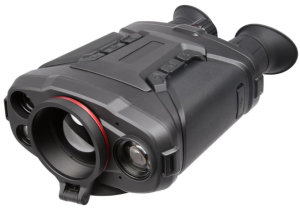
AGM Global Vision has steadily built a strong following among hunters and outdoors professionals who want serious performance without the flagship price tag, and the Explorator TB50-384 is their strongest argument to date.
The unit pairs a 384×288 resolution sensor with a 50 mm germanium objective lens, giving you a combination that punches well above its price class in low-contrast environments like thick timber or misty mornings. The dual-tube design is genuine and comfortable, making it far more practical for extended handheld use than a monocular or adapted single-tube unit.
The 50 Hz refresh rate is retained at this price point, which is meaningful. Some competitors in this bracket drop to 25 Hz to cut costs, and the resulting stuttering image during pans makes a real difference when you are tracking a running deer or following a coyote crossing a field at a trot.
The detection range sits at around 1,350 meters for a human-sized target, which covers the realistic needs of most hunters in North American terrain. The onboard video recording function stores footage to a micro SD card, and the unit is IPX7 rated, meaning it can handle rain and accidental submersion without flinching.
The battery runs approximately seven hours, and the unit charges via USB-C, which is the right call in 2025. The image processing modes, including white-hot, black-hot, and a handful of color palettes, are all usable and switch quickly. For anyone who finds the Pulsar Merger XP50 out of reach but refuses to compromise on sensor refresh rate and build quality, the Explorator TB50-384 is the most logical step down.
| Feature | Specification |
|---|---|
| Sensor Resolution | 384 x 288 |
| Objective Lens | 50 mm germanium |
| Magnification | 3.5x to 14x |
| Refresh Rate | 50 Hz |
| Detection Range | ~1,350 m (person-sized target) |
| Battery Life | ~7 hours |
| Charging | USB-C |
| Weather Rating | IPX7 |
Pros
- 50 Hz refresh rate at a mid-range price
- True dual-tube binocular design
- IPX7 waterproofing for all-weather use
- USB-C charging is modern and convenient
- Onboard micro SD recording included
Cons
- 384×288 sensor is a step down from 640 units
- No built-in rangefinder
The Explorator TB50-384 hits a genuinely compelling sweet spot between capability and cost. If you want a real binocular form factor with a 50 Hz refresh rate and weatherproof durability at a mid-range budget, this unit deserves a serious look before you decide.
Check Price on Amazon3. HIKMICRO Habrok HQ35- Best Value Thermal Binoculars with Laser Rangefinder
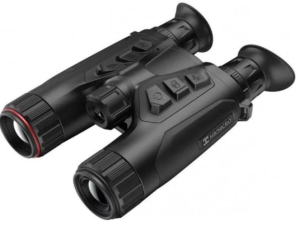
HIKMICRO has become one of the most talked-about brands in the thermal optics space over the past two years, and the Habrok HQ35L is a clear reason why. It delivers a combination of features that would have cost significantly more just three years ago, including a 384×288 sensor, a built-in 800-meter laser rangefinder, dual-tube binocular housing, and a rechargeable battery system, all packaged into a unit that undercuts most of its direct competitors on price.
For hunters who want more than a bare-bones thermal but cannot justify flagship spending, the Habrok HQ35L lands in a very practical position.
The 35 mm objective lens gives you a slightly wider field of view at lower magnifications compared to 50 mm units, which is actually a meaningful advantage for hunting in timber or tracking animals moving through thickets where situational awareness beats raw detection range.
The rangefinder maxes out at 800 meters, which is shorter than the Pulsar’s 1,000-meter unit but more than adequate for the vast majority of real-world hunting situations in North America. The image runs at 25 Hz rather than 50 Hz, which is the primary trade-off at this price point and one worth knowing in advance if smooth panning is important to your use case.
The Habrok series includes a companion app for remote viewing and clip recording, and HIKMICRO has been responsive to firmware updates that have meaningfully improved image processing over the unit’s lifespan. Build quality feels solid for the price bracket.
The rubberized housing is comfortable in cold gloves, the diopter adjustment works well, and the menu system is intuitive after a short learning curve.
| Feature | Specification |
|---|---|
| Sensor Resolution | 384 x 288 |
| Objective Lens | 35 mm |
| Magnification | 2.8x to 11.2x |
| Refresh Rate | 25 Hz |
| Laser Rangefinder | Yes (up to 800 m) |
| Detection Range | ~1,200 m (person-sized target) |
| Battery Life | ~5 hours |
| App Connectivity | Yes (HIKMICRO Sight) |
Pros
- Built-in rangefinder at this price is a genuine rarity
- Wider FOV from 35 mm lens suits close-cover hunting
- App connectivity with recording
- Solid firmware update track record
- Intuitive menu system
Cons
- 25 Hz refresh rate is noticeable when panning quickly
- Shorter rangefinder range (800 m) vs premium units
If you want a laser rangefinder built into your thermal binos without crossing into flagship territory, the Habrok HQ35L is the smartest buy in its class right now. Go check it out and see what the hype is about.
Check Price on Amazon4. InfiRay Outdoor RICO B60- Best Long-Range Detection Thermal Binoculars
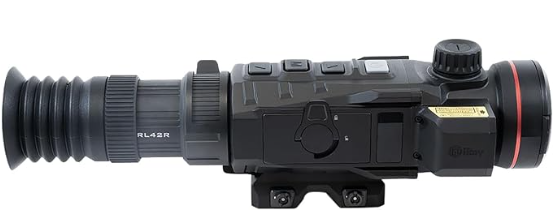
InfiRay has been a dominant force in the Chinese-manufactured thermal optics market and their products have been steadily earning respect in the North American hunting community for good reason. The RICO B60 is their binocular-format flagship and it is built for one thing above all else: seeing as far as thermally possible in a handheld unit.
The 640×512 sensor paired with a 60 mm germanium lens gives the B60 one of the longest detection ranges in its class, with human-sized targets detectable at over 2,000 meters under ideal conditions. For open-country western hunters glassing large basins or high desert flats, that range is a genuine operational advantage.
The 50 Hz refresh rate holds across the magnification range, and the image quality at distance is notably sharp thanks to the high-resolution sensor. InfiRay uses their own image processing pipeline, which tends to produce clean images with less artificial sharpening than some competitors apply.
The dual eyepiece housing is comfortable, and the focus system is smooth and predictable. Battery life is approximately seven hours, and the unit accepts both internal and external power options.
The B60 does not include a built-in laser rangefinder, which is a notable omission at its price point and separates it from the Pulsar Merger in practical field use. The app connectivity and Wi-Fi streaming work reliably. For hunters who prioritize raw detection range and image quality at distance over the convenience of an integrated rangefinder, the B60 makes a strong case for itself.
| Feature | Specification |
|---|---|
| Sensor Resolution | 640 x 512 |
| Objective Lens | 60 mm germanium |
| Magnification | 2.5x to 20x |
| Refresh Rate | 50 Hz |
| Detection Range | ~2,000+ m (person-sized target) |
| Laser Rangefinder | No |
| Battery Life | ~7 hours |
| Weather Rating | IP67 |
Pros
- 640×512 sensor for exceptional image detail
- Best-in-class detection range for this form factor
- 50 Hz refresh rate across all magnifications
- Clean image processing without over-sharpening
- IP67 full weatherproofing
Cons
- No built-in laser rangefinder
- Larger and heavier due to 60 mm lens
- Premium price without the LRF that competitors include
If you glass wide open country and detection range is your single most important criterion, the RICO B60 is the tool that earns its place in your pack. Take a closer look and decide if the distance capability is worth it for your hunting style.
Check Price on Amazon5. Pulsar Accolade 2 LRF XP50 Pro- Best Thermal Binoculars for Professional and Security Use
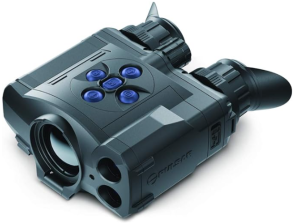
The Pulsar Accolade 2 LRF XP50 Pro is the unit that professionals reach for when the job demands the most reliable performance available without exception. It pairs the same 640×480 sensor and 50 Hz refresh rate that define the Merger XP50 with Pulsar’s most refined image processing to date and a build standard designed to handle hard daily use across extended deployments.
The dual eyepiece design has been refined for long-duration comfort, and the menu system has been streamlined through multiple firmware iterations into something genuinely fast to navigate in the field.
The built-in laser rangefinder reaches 1,000 meters and integrates cleanly with the reticle display, which is useful not just for hunting but for perimeter assessment and observation tasks. The unit connects to Pulsar’s Stream Vision 2 app, which is meaningfully better than the original Stream Vision software: it streams live video, records clips, and allows multiple users to view the same feed simultaneously, which is a practical advantage for guided hunts and team security operations.
The B-pack battery expansion option extends runtime to over 16 hours, which covers even the longest winter nights or multi-shift security rotations. Durability is exceptional: the magnesium alloy housing shrugs off drops, temperature swings from extreme cold to desert heat, and sustained rain without complaint. This is the thermal binocular you buy when failure is not an option and the investment needs to last a decade of hard use.
| Feature | Specification |
|---|---|
| Sensor Resolution | 640 x 480, 17 μm pixel pitch |
| Objective Lens | 50 mm |
| Magnification | 2.5x to 20x |
| Refresh Rate | 50 Hz |
| Detection Range | ~1,800 m (person-sized target) |
| Laser Rangefinder | Yes (up to 1,000 m) |
| Battery Life | 8 hours internal / 16+ with B-pack |
| Housing | Magnesium alloy, IP67 |
Pros
- Magnesium alloy housing built for hard daily use
- Stream Vision 2 app with multi-user live viewing
- Up to 16+ hours runtime with B-pack expansion
- 640×480 sensor with Pulsar’s best image processing
- Integrated LRF with reticle display
Cons
- The highest price on this list
- Heavier than civilian-oriented units
- Overkill for casual or occasional use
The Accolade 2 LRF XP50 Pro is not for everyone, but if you need the most durable, most capable, and most field-proven thermal binocular available for professional or intensive use, this is the standard everything else gets measured against.
Check Price on AmazonFactors to Consider When Choosing the Best Thermal Binoculars
With the market flooded by options at every price point, knowing which specifications actually matter and which are marketing noise is what separates a smart purchase from an expensive regret. Here are the key factors to run through before you commit to a unit.
Sensor Resolution
Resolution is the single most important spec on a thermal binocular. It determines how much detail you can pull out of a heat signature and how well the image holds up as you zoom in. The two common tiers you will encounter are 384×288 and 640×480 (or 640×512). A 384 sensor is more than adequate for hunting at realistic distances in North American terrain.
A 640 sensor delivers noticeably sharper images at longer ranges and makes a real difference when you are trying to positively identify what you are looking at before making a decision. As a general rule, buy as much resolution as your budget honestly allows.
Refresh Rate: 25 Hz vs 50 Hz
The refresh rate determines how many times per second the image updates on your display. At 25 Hz, the image is functional but shows a subtle lag when you pan quickly or when a target is moving fast. At 50 Hz, the image feels live and smooth in a way that becomes immediately apparent in real-world use.
For anyone who plans to track moving animals, scan wide terrain quickly, or use the unit from a vehicle, 50 Hz is a meaningful upgrade. Budget-conscious buyers can work with 25 Hz, but they should go in aware of the trade-off.
Detection Range and Objective Lens Size
Detection range is how far out the unit can register a heat signature for a human-sized target under ideal conditions. Manufacturers publish these numbers under optimal circumstances, so real-world performance in humid air, rain, or heavy timber will be shorter. The objective lens focal length drives this heavily: a 50 mm lens gives you more reach than a 35 mm lens at the cost of a narrower field of view.
Match your lens choice to where you hunt. Close-cover hunting in thick timber benefits from the wider field of view a shorter focal length provides. Open-country glassing rewards the extra reach of a longer lens.
True Binocular Design vs Monocular-Based Units
Not everything marketed as “thermal binoculars” is a true binocular. Some units are essentially a monocular in a binocular-shaped housing with one functional optical channel. A genuine dual-tube binocular delivers a synchronized image to both eyes, which dramatically reduces fatigue during extended glassing sessions.
If you plan to glass for hours at a stretch, a true binocular design is worth paying for. It is always worth reading the specs carefully before purchasing.
Built-in Laser Rangefinder
A thermal unit with an integrated laser rangefinder removes one piece of gear from your kit and streamlines the process from spotting to knowing your distance. This is especially useful for hunters who move quickly or who need confirmed range data fast. The range at which the LRF operates varies by unit.
Premium units reach 1,000 meters or more; value-tier units may cap at 600 to 800 meters. If you already own a reliable standalone rangefinder, this feature matters less. If you are building a kit from scratch, the integrated option is worth prioritizing.
Battery Life and Charging System
A thermal binocular that dies three hours into a pre-dawn hunt is not doing its job. Look for units that deliver at least six hours of runtime on a single charge, and pay attention to whether the unit supports external battery packs for all-night or multi-session use.
USB-C charging has become the standard on quality modern units, which means you can top off from any power bank you are already carrying. Proprietary charging systems are a minor inconvenience worth knowing about before you are in the field without the right cable.
Weatherproofing and Build Quality
Thermal binoculars go where weather happens. Rain, frost, condensation, and the occasional drop are facts of life in the field. An IPX7 rating means the unit can handle submersion in up to one meter of water for 30 minutes, which covers virtually every realistic hunting scenario.
Housing material matters too: magnesium alloy bodies handle impacts and temperature swings better than polycarbonate, though they add weight. Think honestly about the conditions you hunt in and match the build rating to those conditions.
App Connectivity and Recording
Many quality thermal binoculars now offer Wi-Fi connectivity to a companion smartphone app. This lets you stream the live thermal view to your phone, record video clips for scouting documentation, and in some cases share the feed with a partner.
For guided hunts and serious scouting operations, these features add genuine value. For the casual user, they are a nice-to-have rather than a deciding factor. If recording matters to you, confirm that the unit stores footage to onboard memory or a micro SD card rather than requiring an active phone connection.
Frequently Asked Questions About Choosing the Best Thermal Binoculars
What is the difference between thermal binoculars and night vision binoculars?
Night vision amplifies existing ambient light, meaning it requires at least some moonlight or starlight to function. In total darkness it will not work without an IR illuminator. Thermal imaging detects the heat that all living things and many objects naturally emit, which means it works in complete darkness, through light fog, and in conditions where night vision struggles.
Thermal also does not require you to be looking in the right direction when an animal emerges; the heat signature is visible even when the animal is partially obscured by brush. For most hunters and outdoor professionals today, thermal is the more capable choice for active detection.
What resolution sensor do I actually need?
For general hunting use at ranges up to 600 meters, a 384×288 sensor delivers more than enough clarity to identify game animals and make confident decisions. If you hunt wide open terrain, glass at 1,000 meters or more regularly, or want to record footage that holds up to review, a 640-resolution sensor makes a meaningful difference. The jump in resolution brings a corresponding jump in price, so be honest about your actual use case rather than buying the biggest number available.
Is a 25 Hz or 50 Hz refresh rate important?
It depends on how you use the unit. If you primarily glass slowly and methodically from a fixed position, 25 Hz is usable and most hunters adapt to it quickly. If you pan frequently, track moving animals, or use the unit on a moving vehicle, 50 Hz is noticeably smoother and less fatiguing over long sessions. For anyone planning serious active use, the 50 Hz upgrade is worth the extra cost if the budget allows.
Do I need a built-in laser rangefinder in my thermal binoculars?
Not necessarily, but it is a genuine convenience that earns its keep in the field. Carrying a separate rangefinder means one more device to manage, one more battery to charge, and one more step between spotting an animal and knowing your distance.
Units with integrated LRFs streamline that process meaningfully. The trade-off is cost: units with LRFs typically cost more than comparable models without one. If you already own a quality standalone rangefinder, you may find the added expense unjustified.
Are thermal binoculars legal to use for hunting?
In most US states and Canadian provinces, thermal binoculars are legal to use for spotting and observing game, but regulations around using them while actively hunting (particularly while shooting) vary significantly by state and species.
Some states prohibit the use of thermal devices for hunting specific species such as deer. Always check your specific state or provincial regulations before hunting with thermal equipment. Using them for scouting, wildlife observation, and non-hunting outdoor activities is generally unrestricted.
How long do thermal binocular batteries typically last, and can they be replaced in the field?
Most quality thermal binoculars deliver between five and eight hours of runtime on a single internal charge, with some units offering external battery pack accessories that extend that to twelve hours or more. For all-night hunting or multi-day backcountry trips, the external pack option is worth prioritizing. Most modern units charge via USB-C, which makes topping off from a power bank straightforward. It is worth carrying a fully charged power bank as a backup on any serious outing.
Conclusion
Thermal binoculars represent one of the most significant capability upgrades available to hunters and outdoor professionals today. The ability to detect heat signatures at distances of a kilometer or more, in complete darkness, through light precipitation, and in environments where traditional optics are functionally useless, changes the nature of what is possible in the field in a fundamental way.
The five units reviewed here cover a realistic range of needs and budgets. The Pulsar Merger LRF XP50 sets the standard for overall performance and field usability with its 640×480 sensor, integrated rangefinder, and 50 Hz smoothness. The AGM Explorator TB50-384 delivers the same refresh rate at a meaningfully lower cost for buyers who can accept slightly reduced resolution.
The HIKMICRO Habrok HQ35L brings the laser rangefinder down into the value tier with an appealing feature set for hunters on a tighter budget. The InfiRay RICO B60 pushes detection range further than anything else on this list for open-country specialists, and the Pulsar Accolade 2 LRF XP50 Pro sets the bar for professional-grade durability and long-duration performance.
The right choice comes down to where you hunt, how far you need to see, and how long your sessions run. Any of the units on this list will transform the way you glass compared to traditional or night-vision optics. Do your research, match the spec to your real-world conditions, and invest accordingly. Your time in the field will be the better for it.